Monday, December 20, 2010

Week 8 : Let's impress people with the aura !

The aura

Louis XIV of France, also called "The Sun King".


     Have you ever heard somebody say "it's amazing how this person has a hudge aura!"? Mostly these words are dedicated to celebrities, to people of great influence, a charismatic person you know... This is what we can easily say while often we don't even know the real meaning of it. Is it due to the beauty, to the way you stand, the way you move ?


     It's been ages since this notion has appeared among the Humanity, then it was depicted as a halo, a aureola around a holy or a powerful character.  During the Ancient history  it was originally called "aura velificans" and was thought to be a air flow on the top of the head and in order to see it the character was drawn with a  inflated drapery.


The Western Facade of the Ara Paris.

Aiôn mosaic of the Arles Museum.

A Didracma Kamarina (415-405 BC), currency from the Berlin Staatliches Münzkabinett

     Plus it was linked with light during Augustus reign for philosophic and religious reasons. However it was just a representation and was never said to be seeable. The aura was just a meaningful term in art an poetry. It was not just air anymore but light and this is noticeable particularly in pictures representing holy people.

Islamic prophets

Saint Sava, an orthodox saint.
All saints
     A such phenomenon also exists in Indian spirituality, especialy the Hindu and the Buddhists. To them the aura is of seven colours corresponding to mental end emotional impression being the "subtle body". They are considered as the energies of the chakras. A human has 7 chakras that you can see on the picture below (from the top to the bottom : the Crown Chakra, the Brow Chakra, the Throat Chakra, the Heart Chakra, the Solar Plexus Chakra, the Sacral Chakra, the Base Chakra) 
         In the Western world, the aura has been described and explained in many different ways and by many different theories that are more or less occult like theosophy, neotheosophy, neoplatonism, kabala, . It is during the 60's that this topic becomes a real interest until now. To those that believe in auras, it is a field of luminous energy or radiation surrounding a person or an object. People often talk about the "etheric body", it is in fact the lowest layer of the aura, in immediate contact with the skin and connected to the "higher bodies".

                                          
     In addition to it, in 1939, the Russian Semyon Kirlian created a photographic apparatus (based on electricity tension) that enabled to see a phenomenon that some people believe to be the aura.
Kirlian effect observed on different people
     Indeed the theory says that the aura's color and shape is function of the state of mind and the state of health and a stuning experiment occured to confirm this statement, this experiment is called the "phantom leaf effect". A first picture of a leaf has been taken, then the leaf was torn so that only his "skeleton" remains and the result is amazing. 

     As you can see the light phenomenon resulting around the leaf's "skeleton" has the same shape that the entire leaf which would mean it follows a vital flow independently to the physical matter of the leaf. Some other experiments have been made with the Kirlian effect and are more or less an enigma for scientists.


     Neverthless skeptics are totally against the belief of a such thing as the aura and tend to demonstrate that in a scientific or a logic point of view this can't be. Useless to say that the fact that theosophist that believe nature spirit , gnomes and fairires can also be observed was an easy thing to rebutt for skeptics that think (to be short) some observations can be due to the use of drugs. Apart from that skeptics are really trying to fight against the easy ways to make people believe in auras.

                                   
    They refute the fact that the observation of the Kirlian effect corresponds to the aura because many "aura readers" interpret the results differently and there is no consensus on the meanings of the colours. According to them seeing auras is the consequence of a migraine, certain form of epilepsy, a visual system disorder, or brain disorder. Not to mention that synesthesia is a condition found in 1 in 2000 persons and can easily lead to the observation of a colored "aura".

     Even if skeptics have strong arguments, we have not been convinced totally, many other questions remain. As for an example, the way the Kirlian photography is explained doesn't go against the "mystical" theory it just doesn't prove it is absolutely true. 
     Plus  the aura is a very intuitive notion, that we can feel without seeing it. We have all experienced to see someone charismatic without knowing why. And we can easily understand the notion of aura and link it with it.. So according to skepics does love exist? 

     Many Indian beliefs are bound to this notion and with chakras. According to the posture the chakras are well or not. Easy to understand that when you stand in a good way for you body (your bones, your musles...) you feel better. The body and the soul are linked, noone can say the opposite. And someone that feels good, looks good, maybe it is far-fetched to say that looking good is a part of the charisma, but would you think an actor is charismatic as long as he looks sick ?

     Also as we said the faculty to see tha aura has something to do with the "third eye" in some mystical religions. Well some animals like some lizards, frogs, lampreys, fishes, arthropods have a "parietal eye" on the top of their head that looks like a dot (brighter or darker according to the species). Let's see the photographs below.
     The role of this eye can be photoreception, regulation of a cycle in the biochemical, physiological, or behavioural processes, the production of hormones for thermoregulation.
Third-eye, Brad Holland
     Birds and mammals like us have not this organ but we have the gland linked with this organ. Intuitively again we can think we have biological dispositions for more receptivity than just what we can touch or see. Maybe our psyche is linked with it?
Non-contractual photograph of Sigmund Freud

     And most of all Skeptics use scientific arguments while it is very well known that Science cannot explain everything. There were times when Science couldn't find explanations for phenomenons like the blue color of the sky, but it didn't mean the sky was not blue and even if in a time some mathematical calculations could have proved the sky was red. 

     Why won't we follow our intuition in order to simply try to find answers to make this phenomenon clearer? Why would we skepticaly refute every questionable thing? Don't skeptics know that the first step of a scientific research is intuition. That was clearly explained by René Descartes in his Discourse on the Mehtod.

     We are not for or against the belief of the aura, we just believe this is still something to be explained. Maybe something close to what is described in mysticism has a reality, but is would go far beyond the complexity that we reach with the current state of the scientific research. When we see the time and work that is needed to completely find the functions and the roles of a single protein in a living being it is easy to understand that a global phenomenon like the aura still isn't explained.

     Maybe we have many hints in researches that have already been done. Indeed, we are all emanating energies like heat, radioactivity (130Bq per kilograms) and it could be because of the state of our organs, all that is in it, psyche has a major role for everything but it certainly isn't magical. It probably is due to something that goes over the complexity  of the living far beyond the molecular cocktail, genetical programs, the many physical laws so that it isn't easy to handle for the Science.
          In order to finish on a funny note here are some exercices to see the aura or the etheric body, you can make it with your friends during a dinner. Here are some web sites extracts : 

 The energy almost always moves from left to right around the circle. It feels very unpleasant to stop, and usually it is impossible to stop the entire flow. The feeling of building something up between your hands is that of a tickling sensation with pressure, somewhat like static electricity. When the energy body edges touch each other, there is a feeling of tingling and of pressure. When the energy body edge touches the skin, there is a feeling of tickling and pressure on the skin surface. When you draw circles on the palm, you can feel the tickling outline


Most people see a haze around the fingers and hands when trying to sense the aura. It looks somewhat like the heat wave over a radiator. It is sometimes seen in various colors, such as a blue tint. Usually, most people see it as colorless in the beginning. The energy bodies pull like taffy between the fingers as the haze from each fingertip connects to the haze at the fingertip of the opposite hand. When you move the fingers so that a different fingertip is facing it, the haze will at first follow 

In order to see the etheric body you can also put you hand like this with your fingers that you fold this way behind a white background.


You will perceive between those two finger a little light shadow tainted in blue that surrounds your fingers and to the closest point you will perceive the etheric currents as little lines that tend to be confused and that will trigger a little tingel. You'll have the impress of a little sticky layer due to the etheric fields.
If you do the same thing with using one finger of each hand, you'll observe the current alternating passing from one finger to the other creating a little conic shape. The more you will practice, the easier it will be for you to see the etheric body and you will notice his thickness variates according to the state of health or the fatigue.


Webography :

Monday, December 6, 2010

Week 7 : Let's impress people with Life !


Does Life depend on the Sun ?


  • Food chain

As you all know, food chain is the link between all species in an ecosystem by considering the predator-prey relationship. "What are the preys of this creature ?" is the key question and if you repeat the question on each prey it will lead you to autotroph species, in other words plants and phytoplankton.


Indeed those organisms don't hunt, they have no prey because they create their own food. That is why they are the first level of the food chain.

Photosynthesis use chloroplasts inside the cells

How do they create their food ? Again, you know it. Thanks to the famous chemical reaction called photosynthesis. 


As you can see this reaction involves light provided by sun. So it is easy to concluded that without sun there is no photosynthesis, so, there is no plants and phytoplankton which are the first level of food chain, and so, no life on earth.


  • Deep sea creatures

What about those monsters that live in the depth, never see the sunlight, hunt in an ecosystem with no phytoplankton and can produce their own light ?

Angler fish (it use a luminous lure to attract its preys)

Another angler fish (even more cute don't you think ?)

It seems that they escape from our conclusion. Well, not really. Actually they depend on the food from above, the food chain in the depth is based on scavengers which eat corpses that drift down from the water surface and so, without sun they couldn't be able to feed themselves.

Hagfish (As you can notice it has no eyes, this is because it lives in total darkness)

Hagfish (beautiful teeth but no jaws)

Hagfishes are scavengers (here they are eating a whales corpse)


  • Black smokers and cold seeps

Well, even in the darkest area, the sun seems to be the key to provide life, so the answer to the question " Does life depend on the sun ? " should be "Yes" . Not so fast !

Giant tube worms

In 1977 scientists discovered ecosystem around hydrothermal vents. That was an incredible surprise because the conditions are extreme, 80°C, very salty water, hight pressure (100 to 500 times stronger pressure).

Black smoker surrounded by tube worms

The food chain there is based on chemosynthetic bacteria that can produce organic material from hydrogen sulfide thanks to chemosynthesis 

6CO2 + 6H2O + 3H2S = C6H12O6 + 3H2SO4

In 1990 another sun-independent ecosystem has been discovered, called the cold seeps.

Underwater lake

Underwater lake

It also relies on chemosynthesis but this time not mainly from hydrogen sulfide but methane. 


  • Personal commentaries 
So the answer to the question "Does life depend on the sun ?" is "No", there is life, in black smokers and cold seeps, that can live without sun but it is a highly rare phenomenon and anywhere else the answer would be yes, and even in those ecosystems a total independence is uncommon because most of the creatures needs oxygen which is provided, again, by photosynthesis and so depends on sun.

The most exciting thing about that is maybe that discovery and exploration is still possible, scientists discovered those places only 34 years ago and less than 1% of the surface of depth area has been  explored. In other words our childhood dreams of adventure in unexplored and wild realm is "feasible". Moreover you also will have to face monsters such as giant squids or angler fishes. Isn't it like a real epic adventure novel ?

"Twenty Thousand Leagues Under the Sea" novel by Jules Vernes

 Giant squid illustration

Giant squid illustration 

What about the underwater lakes ? Isn't it wonderful ? To us it is a fantasy story becoming real.
One of our most beautiful dream would be to be offered a journey into a submersible, 5 000 meters deep.

Real submersible

Unreal submersible

Another interesting aspect is that some scientists think that those ecosystems might be the birthplace of life on earth. 

Bibliography/Webography :

BBC movie "Planet earth" episode 11 Ocean deep.
"Abysses" book by Claire Nouvian

Wonderful book I recommend you to look at

Saturday, November 27, 2010

Week 6 : Let's impress people with love !

It’s been five weeks now that we have been trying to give you some key topics to impress your guests. Talking about stunning subjects can make you sound cultivated. But as you may have noticed it yourself, every now and then, some people that know plenty can seem rather limited when it comes to real thinking. That’s why this week we’ll develop ideas about a question that may be very interesting to deal with during a dinner as it’s often the opportunity to meet and seduce people…And the question is :

Is Love blind?

To make a catchy treatment of this question we’ll oppose a philosophical and a scientific approach. We chose a text of Jean-Jacques Rousseau that deals with this question because he is famous so that your friends will not be lost during your “passionate speech”. The opposite answer to the question will come from a scientific research of neurobiology.


1712 - Jean-Jacques Rousseau, philosopher,
born in Geneva, Switzerland
One of the major French philosophers, and most of all the composer of 18th-century Romanticism, Jean-Jacques Rousseau wrote about it in his novel Emile: Or, On Education. This writing is a treatise about education and human nature. It is composed of five books about Emile’s life to illustrate his education. The fourth book is about adolescence, it is in this part that Rousseau broaches “sentiment”, said to be the last part of education, and raises the issue of knowing whether Love is blind. 


Here is an excerpt from the book that shows that Love cannot be blind for all the judgments it implies and that we’ll explain after you read the text. You also have the choice not to read it if you don’t have much time, however we advise you to just because it is remarkably written.

« The direction of the instinct is uncertain. One sex is attracted by the other; that is the impulse of nature. Choice, preferences, individual likings, are the work of reason, prejudice, and habit; time and knowledge are required to make us capable of love; we do not love without reasoning or prefer without comparison. These judgments are none the less real, although they are formed unconsciously.
True love, whatever you may say, will always be held in honour by mankind; for although its impulses lead us astray, although it does not bar the door of the heart to certain detestable qualities,
although it even gives rise to these, yet it always presupposes certain worthy characteristics, without which we should be incapable of love. This choice, which is supposed to be contrary to reason, really springs from reason. We say Love is blind because his eyes are better than ours, and he perceives relations which we cannot discern. All women would be alike to a man who had no idea of virtue or beauty, and the first comer would always be the most charming. Love does not spring from nature, far from it; it is the curb and law of her desires; it is love that makes one sex indifferent to the other, the loved one alone excepted. »

For those that understand the French language they’ll sure appreciate the beauty of this essay in its original version. We couldn’t not show you this. Plus, you can even show more off if you say you read it in French…


           « Le penchant de l'instinct est indéterminé. Un sexe est attiré vers l'autre, voilà le mouvement de la nature. Le choix, les préférences, l'attachement personnel sont l'ouvrage des lumières, des préjugés, de l'habitude ; il faut du temps et des connaissances pour nous rendre capables d'amour, on n'aime qu'après avoir jugé, on ne préfère qu'après avoir comparé. Ces jugements se font sans qu'on s'en aperçoive, mais ils n'en sont pas moins réels. Le véritable amour, quoi qu'on en dise, sera toujours honoré des hommes ; car, bien que ses emportements nous égarent, bien qu'il n'exclue pas du coeur qui le sent des qualités odieuses et même qu'il en produise, il en suppose pourtant toujours d'estimables sans lesquelles on serait hors d'état de le sentir. Ce choix qu'on met en opposition avec la raison nous vient d'elle ; on a fait l'amour aveugle parce qu'il a de meilleurs yeux que nous, et qu'il voit des rapports que nous ne pouvons apercevoir. Pour qui n'aurait nulle idée de mérite ni de beauté, toute femme serait également bonne, et la première venue serait toujours la plus aimable. Loin que l'amour vienne de la nature, il est la règle et le frein de ses penchants. »

In other words, one of the first arguments is that to love implies to prefer someone and we do not prefer without comparing. Comparison implies reason so love is not unrelated to reason thus love cannot be blind. Tastes are the result of your life experience; it is something that is proper to someone. All the more we grow up, all the more we distinguish what we really like or not.


Moreover, we all have different minds that’s why we process what we see, what we learn in different ways. You will never like exactly the same things as someone else because you haven’t had the same life. And at the same time, have you ever experienced the fact of being surprised to love something or someone? It means that even if you realise that with Experience you become more aware of your tastes you are not conscious of the entire process.


To conclude, the sentence “We say Love is blind because his eyes are better than ours” means that if we know what we prefer, we don’t always know why. Because we know our tastes are developed during our life it means they are the result of an education. And as we said previously, what we like or dislike is proper to ourselves in a way that is not conscious so that we don’t understand. And when our Reason is excluded from understanding Love we believe erroneously that Love is unreasonable, blind.
This thought leads to the famous quote of Blaise Pascal “The heart has its reasons of which reason knows nothing”. Many other things can be said about this text but I focused essentially on answering our weekly question.


Now, let’s see what science has to say about what love triggers on our brain with two groups of neuroscientist that figured out that love was blind though their experiments on men and women.
A study led by New York neuroscientists on the effects of love on the brain consisted in observing trough MRI the brain zone affected by the vision of the beloved. Mostly female responded drastically by activating the brain zone of the “motivation and reward” system just like drug consumption. It implies also the inefficiency of the judgment system.


Concerning men, a Canadian experiment consisted in choosing between getting an amount of money immediately or a bigger amount but later in the year. The best choice would be to choose the bigger amount. But during the experiment, men were shown attractive women pictures and women attractive men pictures. Only some men failed in choosing which made the scientists think they were unable to think appropriately about the situation as long as they were attracted to a woman. 
 
We can conclude from those studies that scientific community can be easily incline to believe that love is blind or at least that is put blinkers on our eyes. 

With these two symetrically opposed points of view you have now a basis to confront with your friends about this question. However never forget to give your personnal opinion on this passionate subject. If we had to discuss about love in such terms we would consider the the real question as to redefine love. Is it just a feeling? A notion ? An utopia ? Could it be different things according to people? Is it when Passion and Reason meet or split? Enjoy the diner...


Bibliography/Webography:


Science. 2003 Nov 21;302(5649):1320.
Society for Neuroscience meeting. Caudate-over-heels in love
Proceedings of the Royal Society B december 2003

http://bette.aecom.yu.edu/Media/science_love.pdf

Sunday, November 21, 2010

Week 5 : Let's impress people with the Stanford prison experiment

          Your friends may have heard about the famous Stanley Milgram experiment, in which, participants were ordered to give fake electric shocks to an actor  (without knowing that they were fake), and so, at a higher voltage each time the actor didn't succeed to answer a memory question; ending with a lethal electric shock.

The results of this experiment were a huge surprise, indeed 65% of the participants  follow the order until the end and did not rebel.

But have your friends heard about the Stanford prison experiment ? Which is just as astonishing !


  • The experiment 

This experiment occurred in 1971 and directed by Psychology professor Philip Zimbardo at Stanford University.

The goal was to study the psychological effects of the prison on people who embody the role of guards and prisoners.
Professor Philip Zimbardo

Professor Philip Zimbardo and his team selected 24 male, they judge psychologically stable and healthy, among 74 people who respond to the offer to participate for a two-weeks prison simulation paid 15$ (It correspond to almost 75$ nowadays).

The roles between guards and prisoners were given randomly and then everything has been establish so that they embody their role.


Prisoners were realistically arrested at home, the police took their fingerprint and they had to wear uncomfortable clothes, no underwear and also a chain on their ankle.


As regards for the guards, the researchers gave them batons and military clothes, and then they tell the guards that they were in charge of the prison and that they could manage it the way they want. But of course they have been forbid to use violence.


  • The results

The experiment should last two weeks but it has been stop after only 6 days, indeed the experiment rapidly turned out to be a dangerous mess. From day 2 the prisoners start to rebel but the guards succeed to eradicate the riot and start to work unpaid extra hours. No more rebellion occurred but the treatment of the prisoners gets worse and worse

The guards begin to make the prisoners accomplish humiliating task such as cleaning toilets with the hands.


They used psychological tactics such as a the establishment of a "privilege cell" in oder to make the prisoners believe that they were informers among them. They also strip them naked, sexually taunt them and do others degrading activities.
Finally one-third of the guards revealed sadistic behavior.


This situation triggered many severe emotional break down among the prisoners, and the professor Philip Zimbardo himself acted improperly by refusing to release some seriously disturbed prisoners for a while. The experiment would have probably last longer if Christina Maslach didn't beg Zimbardo to stop it immediately after she interviewed some prisoners.


  • Personal commentaries 


This experiment is to us really scary, it's looks like a descent into hell. Obviously the first thing we had in mind was "How would we have react ?" but the fact is that we cannot know because it's seems that the personality is a minor factor in such situation.
We are used to think that we are simply good people but no one is immune to horrifying behavior. Which is quite disturbing and difficult to accept, don't you think ? Aren't we not the master of our behavior in a crisis ?

The second though we had in mind was "Are we more likely to act the good way now that we know about those experiments?". Give us your answers.

We regret that some of the participants suffer from severe emotional disturbance, and so, only for an experiment. Moreover there is many critics to do against the researchers, on the paper, the experiment was fine but they made some mistakes.
For example they should never accept the guards to do extra hours, because the camera were turn off so they were not able to control them. And as you can guess the worst thing happened at night.

But, in the other hand, it is also very interesting because it ask many questions and gives some part of the answer. We would say that this experiment is even more fascinating that the Milgram experiment because, both of them talk about blind obedience and diffusion of personal responsibility, but the Stanford prison experiment talks also about the importance of costumes to feel out of oneself, sadistic tendencies, passive tolerance and conformity to group.
Finally the thing that concerns us the most is, why the prisoners embodied their role of the victim so much. Why they felt like they deserved it ?


Our advises would be to watch the German movie "Das experiment" by Oliver Hirschbiegel. This is a stunning movie, inspired by the Stanford prison experiment, in which you can feel the rising of abuse of power from the inside. The beginning is very close to the real experiment but of course the end is much more dramatic. It's a movie after all.
Besides, another movie entitled "The Stanford Prison Experiment" is in production and will probably be released in 2011.

The optimistic conclusion would be to notice that if no one is intrinsically good, it also mean that no one is intrinsically bad.

Webography :

http://www.holah.karoo.net/zimbardostudy.htm

http://en.wikipedia.org/wiki/Stanford_prison_experiment

http://www.lucifereffect.com/movie.htm

http://en.wikipedia.org/wiki/Milgram_experiment

http://www.prisonexp.org/

Monday, November 15, 2010

Week 4 : Let's impress people with Siberian Foxes


The Silver Fox experiment

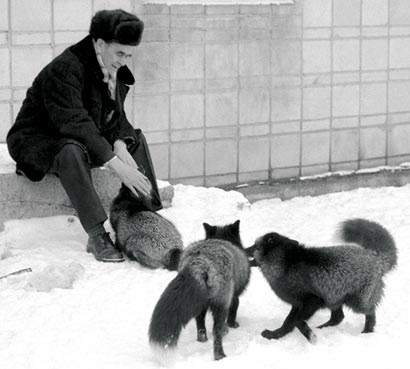
This story started in 1959 in the Institute of Cytology and Genetics of the (former-)U.S.S.R. Academy of Science in Novosibirsk, Siberia. A Russian scientist called Dmitry K. Belyaev, director of this institute, intended to carry out experiments on animal domestication process. The most famous case of domestication is the case of Canis lupus (wolf) becoming Canis familiaris (dog).
In order to chose a proper subject for his experimentations he wanted an animal that could be genetically close to the dog and the wolf and at the same time that still hasn’t been domesticated, just like foxes. As Siberia was abundant in silver foxes bred for their fur, it was the opportunity for Belyaev to work on his project with these foxes.
Dmitry Belyaev with some of his domesticated silver foxes, in 1984.


His experimental process was quite simple to understand and to set up. In every litter he would select the fox cubs that showed no aggressiveness and the less fear towards homo sapiens as possible. The results came quite quickly, that is to say that in a remarkably small number of generations (10 to 15 generations) some physical characteristics appeared to differ from usual foxes.


Only by selecting foxes on behaviour it changed their physical aspect. Those changes led to the fact that foxes look more “cute”. Indeed they had juvenile characteristics : floppy ears, large skull for their length, curved tail. Also they had lack of pigmentation as their new ecological niche (cages) didn’t require to stay hidden. In other words they looked more like
dogs.
          White areas on the fur                                curved tail                                         floppy ears


            Keeping juvenile traits as adult is called neoteny. This is a natural process that makes babies look cute so that their parent have a greater tendency to take care of them. Very easy to demonstrate that the more it looks cute the more we want to take care of it.

Let’s make a simple test : if you were a parent and you had two kids (supposedly the pair of pictures below) and you had to decide to take care the most about one of them. To which one do you thing you would pay more attention?


As a conclusion this experiment showed that selecting individuals by behavioural traits ( here tameness, friendliness with humans) triggered physical changes. Those changes are to be compared with wolves and dogs. Wolves have been keeping mainly the same aspect and behaviour for a long time (like foxes that were not selected). Dogs show much more difference with wolves in a juvenile way (like selected foxes in few generations). This can explain how today there is plenty of dog breeds, with different physical characteristics.


Dmitry Belyaev died in 1985 and the experiment are from that year under the direction of Lyudmila N. Trut (picture below). It is now 50 years that these experiments last for the good of genetic and metabolic researches. After all, even if they are still helpful to science progress and cause no physical pain on foxes they still involve animals in cage. Some are even sold as pets.
Once a wise man1 said "the day we'll realize animals have a thought without language we'll die of shame for locking them up in zoos" This is the dilemma it is all about.


Bibliography :

 Lyudmila N. Trut, Early Canid Domestication: The Farm-Fox Experiment, American Scientist, volume 87

1The wise man is Boris Cyrulnik an etholog, quoted from La fabuleuse aventure des hommes et des animaux with Karine Lou Matignon, Frédéric Fougea.

Webography :

http://en.wikipedia.org/wiki/Domesticated_silver_fox
http://en.wikipedia.org/wiki/Neoteny

Sunday, November 7, 2010

Week 3 : Let's impress with Synesthesia (Part 2)

How to talk about synesthesia

  • FOR YOUR  AESTHETIC FRIENDS :
"Don't shut the door please, I don't like the taste of it ", "Klein blue smell like a lily of the valley" " Your music is a firework of color"

Well as you can see synesthesia can be a very pleasent feeling and your friends concerned by beauty will necessarily envy those synesthetes that can experience enchanting sensations they will never feel. Actually they could by consuming psychedelic drugs but we highly recommend not to have such a behavior.


For them you will have to focus on exquisite talks such as in the videos below:


  • FOR YOUR SCIENTIFIC FRIENDS :

Well while you aesthetic friends were fine with thoses information, your scientific-minded friends will be more skeptical and will ask for proofs. No problem, a lot of experiments have been made, one of those is to ask non-synesthetes and synesthetes to find the geometric shape made by the "2"s on the picture below on the left.

It will be very long to non-synesthetes to find out while it is almost instantaneous for synesthetes because they see the left picture like the one on the right. 

Those interested in neuroscience will be glad to see in synesthesia a perfect example to demonstrate that the brain is fragmented in areas and that these areas can interact between them.


Each area is dedicated to a function

Those links between different area of the brain does not affect only synesthetes for example, in the picture below, acording to you, which shape is called Kiki and which one is called Bouba ?


95% to 98% of people answer the same thing, Kiki for the angular shape (on the left) and Bouba for the rouded one (on the right). Isn't it amazing ?!

  • FOR YOUR CULTIVATED FRIENDS :


They will appreciate to learn that some famous artists were synesthetes and that of course it had influenced their works, people such as:

               Jean Sibelius
               Nikolaï Rimski-Korsakov
               Olivier Messiae
               Franz Liszt
               Vassily Kandinsky (not sure)

 or contemporary such as:

               Pharell Williams
               Thom York (Radiohead)
               Richard D. James (Fall out Boys). 

You can easily refer to the poem "Voyelles" by Rimbaud and " Correspondances" by baudelaire but actually none of both were synesthete. 

But the most important would be to advise to read the book "Born On A Blue Day" an autobiography by Daniel Tammet, which may be the most intense case of synethesia, where he reveals a lot about his synesthesia and much more (he is an incredible character and his life is quite amazing).